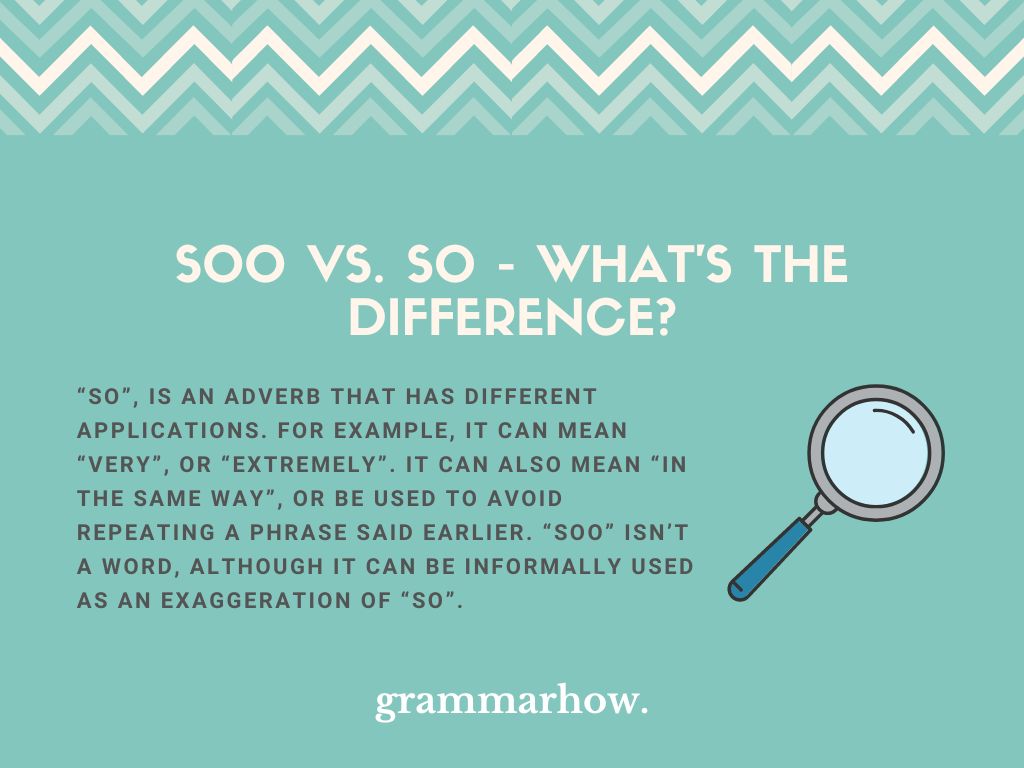
Soo vs. So: Understanding the Grammatical Difference
The English language, with its rich tapestry of words and often perplexing homophones, frequently presents challenges even for native speakers. Among these, the subtle yet significant distinction between "Soo" and "So" often causes confusion. While they sound identical, their usage, meaning, and grammatical function are vastly different. "So" is a versatile and common word found in everyday speech and writing, performing multiple roles from an adverb of degree to a conjunction of result. "Soo," on the other hand, is not a standalone common English word but typically appears as a proper noun, a name, or part of a geographical place name, carrying a specific, unique identity. Understanding this fundamental difference is key to clear and effective communication. This article will delve into the nuances of each term, providing clarity and practical examples to help you master their correct application.
The Grammatical Lowdown: Decoding "So"
"So" is a remarkably flexible word in English, serving various grammatical purposes that make it one of the language's workhorses. Let's explore its primary roles:
1. As an Adverb of Degree or Manner
"So" is frequently used to intensify adjectives or adverbs, meaning "to such a great extent" or "very."
- Degree: "The coffee was so hot that I couldn't drink it." (It was very hot.)
- Manner: "She sings so beautifully." (She sings in a very beautiful way.)
- Comparison: "He wasn't so enthusiastic about the idea as I was."
It can also mean "in this way" or "thus."
- "Hold the brush so." (Hold it in this manner.)
2. As a Conjunction
One of the most common uses of "so" is as a coordinating conjunction, linking two independent clauses and indicating a result or consequence.
- Result: "It started raining, so we decided to go inside." (The rain was the reason we went inside.)
- Purpose (often with 'that'): "He studied hard so that he could pass the exam." (His purpose was to pass the exam.)
It can also introduce a clause of purpose or explanation without "that," often after an imperative.
- "Be quiet, so I can hear what she's saying."
3. As an Interjection
"So" can be used as an interjection to express surprise, understanding, or agreement, or to prompt someone for more information.
- Surprise/Understanding: "Oh, so that's what you meant!"
- Inquiry: "So, what happened next?"
4. As a Pronoun Substitute
In certain contexts, "so" can substitute for a previously mentioned clause or idea.
- "Are you coming to the party?" "I think so." (I think I am coming to the party.)
- "He said he was tired, and so he was." (He was indeed tired.)
Tip for "So": If you can replace it with "therefore," "very," "as a result," or "in this way," you're almost certainly using the correct "so."
Unraveling "Soo": A Unique Identity
Unlike its homophone "so," "Soo" is not a standard English word with multiple grammatical functions. Instead, when you encounter "Soo," you are almost invariably looking at a proper noun – a specific name of a person, place, or occasionally a brand. This distinction is crucial because it highlights "Soo"'s role in identifying something or someone unique, rather than conveying a general concept or relationship.
"Soo" as a Personal Name
"Soo" is a relatively common given name, particularly in East Asian cultures, where it might be a standalone name or part of a longer name. For instance, it is often encountered as a Korean surname or a component of a given name, frequently carrying beautiful meanings like "water" or "excellence." When we refer to individuals, "Soo" acts as a unique identifier.
Consider the prominent South Korean actress,
Soo Ae. Her name, "Soo Ae," exemplifies "Soo" as a proper noun referring to a specific person. As a celebrated public figure, it's natural for fans and the curious to seek information about her career, achievements, and even details like her public persona or
soo ae net worth. While specific figures for personal net worth are often estimates and can fluctuate, the very query demonstrates how "Soo" in this context refers to a distinct individual whose public life generates interest. It's an example of how a name, even a simple one like "Soo," can become a gateway to a wealth of biographical and professional information.
"Soo" in Geographical Names
Beyond personal names, "Soo" frequently appears in geographical designations, most notably in North America. These instances are almost always derived from Indigenous languages or historical nomenclature. The most famous example, which we will explore in detail, is the "Soo Locks." Here, "Soo" is an abbreviation for "Sault," derived from the French word for "falls" or "rapids," specifically referring to Sault Ste. Marie. This usage underscores its function as a part of a specific proper name for a location or structure.
Key Takeaway for "Soo": If it's capitalized and refers to a specific person, place, or organization, you're likely looking at "Soo." If it's a common word describing degree, consequence, or manner, it's "so."
The Iconic Soo Locks: A Case Study in "Soo"
Perhaps the most famous and illustrative example of "Soo" in English usage is the
Soo Locks. Located in Sault Ste. Marie, Michigan, and Ontario, these impressive engineering marvels are critical to Great Lakes shipping. They allow ships to bypass the 21-foot drop between Lake Superior and the lower Great Lakes (Huron, Michigan, Erie, and Ontario), facilitating the movement of iron ore, coal, grain, and other vital commodities.
The name "Soo" in "Soo Locks" is a phonetic shorthand for "Sault," specifically from "Sault Ste. Marie," meaning "Rapids of St. Mary." These rapids historically made navigation between Lake Superior and Lake Huron impossible for large vessels. The construction of the locks transformed this bottleneck into a bustling gateway, making Sault Ste. Marie a pivotal point in North American commerce and history.
Each year, the reopening of the Soo Locks for the shipping season is a momentous event, signaling the official start of spring for many in the Great Lakes region and marking a crucial milestone for the shipping industry. The first ship of the season passing through the locks is often celebrated, drawing spectators and media attention. This annual tradition highlights not only the economic importance of the locks but also their cultural significance as a symbol of regional heritage and resilience. You can
watch the Soo Locks open: a sign of spring and shipping season to witness this fascinating process. The existence and prominence of the Soo Locks powerfully demonstrate that "Soo" functions as a unique identifier, a proper noun rooted deeply in specific geographical and historical contexts, completely distinct from the grammatical roles of "so."
Avoiding Common Pitfalls: When to Use Which
Mastering the distinction between "Soo" and "So" boils down to understanding context and grammatical function. Here's a quick guide to help you make the right choice:
*
Think Function:
* If you're expressing a degree ("very"), a result ("therefore"), a purpose ("in order that"), or simply asking for more information ("what happened next?"), you need
"so."
* If you're referring to a specific name – a person like Soo Ae, a place like the Soo Locks, or any other proper noun – you need
"Soo."
*
Check Capitalization:
* "So" is typically lowercase unless it starts a sentence.
* "Soo" is almost always capitalized, as it's a proper noun.
*
Test for Replacement:
* Can you substitute "so" with "very," "as a result," or "in this manner"? If yes, use "so."
* Can you substitute "Soo" with a generic word like "river" or "person"? No, because "Soo" *is* the specific identifier.
Practical Examples for Clarity:
- Correct: "The movie was so engaging that I watched it twice." (Adverb of degree)
- Incorrect: "The movie was Soo engaging..."
- Correct: "Soo-won is a character in my favorite book." (Proper noun, part of a name)
- Incorrect: "So-won is a character..." (Unless 'So' is a specific, known name here, which is less common)
- Correct: "The Great Lakes freighter passed through the Soo Locks." (Proper noun, place name)
- Incorrect: "The freighter passed through the So Locks."
- Correct: "She trained hard, so she was ready for the marathon." (Conjunction of result)
- Incorrect: "She trained hard, Soo she was ready..."
In essence, "so" is a workhorse of grammar, handling a variety of everyday linguistic tasks. "Soo," on the other hand, is a specific label, pointing to something unique in the world, whether it's a person, a place, or an identifier.
In conclusion, while "Soo" and "So" share an identical pronunciation, their grammatical roles and meanings could not be more distinct. "So" serves as a versatile common word, functioning as an adverb, conjunction, or interjection, adding depth and connection to our sentences. "Soo," conversely, stands apart as a proper noun, a unique identifier for individuals like the acclaimed actress Soo Ae, or significant geographical landmarks such as the vital Soo Locks. Recognizing "Soo" as a proper noun is key to understanding its usage, whether it refers to a person whose career and personal details like
soo ae net worth might be of interest, or to an engineering marvel that plays a crucial role in international shipping. By keeping these clear distinctions in mind, you can confidently navigate the nuances of the English language, ensuring your communication is always precise and grammatically sound.